SGAEIA Research Series — Article 20
Aridio Silva
Independent Researcher, Brazil
Creator of SGAEIA — Secure Governed Autonomous Edge Intelligence Architecture
ORCID: 0009–0008–2411–6995
Copyright: © 2026 Aridio Silva | License: CC BY 4.0
Abstract
The distinction between AI agents and agentic AI is conceptually defensible when it separates an entity that acts, the properties of its behavior, and the system that enables goal completion. However, the literature and providers do not establish a universal boundary between two technologies. An agent can carry out extended processes, and an agentic system can contain a single agent. This article examines academic antecedents, contrasts recent taxonomies, and compares terminology used by OpenAI, Anthropic, Google, Microsoft, and other providers. It offers an explicitly non-consensus teaching framework and explains why autonomy, agent count, content generation, learning, and authority should be analyzed separately.
Keywords: AI; intelligent agents; agentic AI; autonomy; multi-agent systems; language models; governance.
1. The right question does not start with agent count
Consider an assistant tasked with researching suppliers, checking commercial terms, and preparing a recommendation. It could follow a fixed sequence of model calls, select its next search based on the results, or distribute the investigation among several agents. All three arrangements could use the same language model. What changes is the organization of decisions and actions, rather than necessarily a new kind of model.
It is tempting to call the first arrangement an AI agent and reserve agentic AI for the third. That classification mixes two criteria: the number of components and execution autonomy. It also leaves out the second arrangement, in which one agent controls a process through feedback. Analysis should first identify the level being described: the agent, its behavior, or the architecture.
This article is a critical narrative review of primary sources, rather than a systematic review, an original experiment, or a provider performance evaluation. Academic papers, preprints, white papers, and commercial documentation serve different purposes and have different validation histories. Official documentation establishes how a provider uses a term; it does not make that usage a universal scientific definition. Mutable pages are considered as examined in the research completed on 14 October 2026.
2. Agents predate language models
In the tradition of Russell and Norvig, an agent receives percepts from an environment and produces actions. The agent function maps percept histories to actions, while a program implements that function within an architecture. Rationality means selecting actions according to a performance measure and the available information; it implies neither perfect knowledge nor guaranteed success. This account includes reflex agents, goal-based agents, utility-based agents, and learning agents. [1]
Wooldridge and Jennings discuss autonomy, reactivity, proactiveness, and social ability, while recognizing that agent already had multiple interpretations. Shoham examines agent-oriented programming, and Rao and Georgeff develop the BDI tradition, based on beliefs, desires, and intentions. These antecedents show that goal representation, deliberation, and coordination did not originate with LLMs. An agent may be reactive, symbolic, robotic, or based on reinforcement learning. [2–4]
The word agentic also has precedents outside computing. Bandura uses it in discussing human agency, including intentionality, forethought, and self-regulation. Here that reference provides linguistic and conceptual background, based on the publisher's public abstract, rather than evidence that computational systems possess subjective experience or human intentionality. Sharing a word does not justify importing its psychological assumptions into a technical definition. [5]
LLMs have made natural-language interfaces, tool selection, and adaptation to open-ended tasks more practical. ReAct demonstrated the integration of expressed reasoning and actions with observations from the environment; the survey by Wang and colleagues organizes components such as planning, memory, and tool use. These works characterize important developments within the subclass of language-based agents. They do not retrospectively redefine the entire history of intelligent agents. [6,7]
3. A useful distinction: entity, property, and system
An AI agent can denote the functional unit to which observations, decisions, and actions are attributed. Agenticness can describe the control profile of that unit or of a composition in a particular task. An agentic system can denote the collection of agents, tools, state, and execution mechanisms that enables goal pursuit. In this article, separating these levels is the author's analytical synthesis, rather than an established terminology standard.
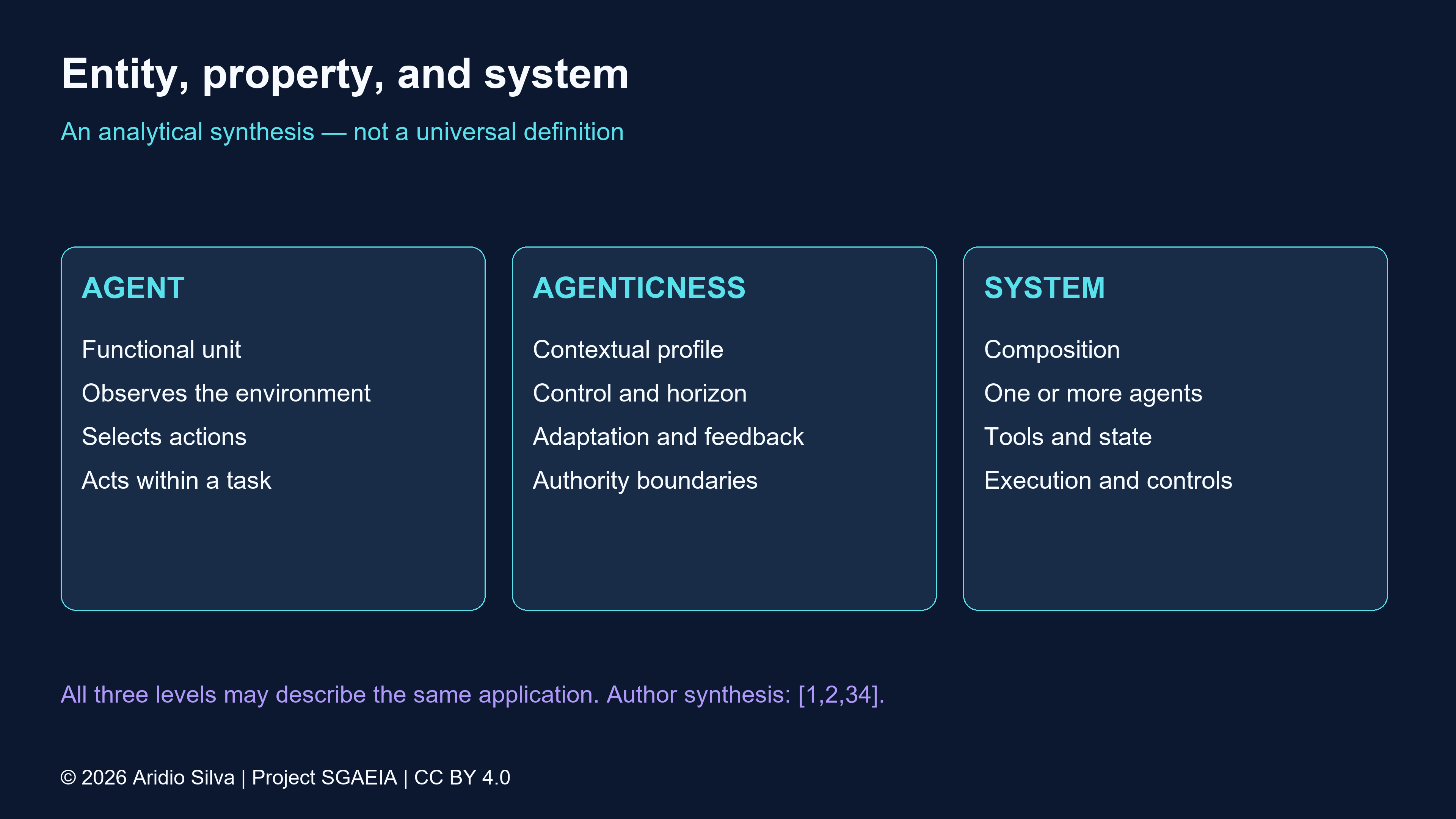
Shavit and colleagues were already treating agenticness as gradual in 2023. Their work discusses goal complexity, environmental complexity, adaptability, and execution independence as relevant dimensions. This supports understanding agenticness as a contextual property, but the source is a governance white paper produced by OpenAI researchers. It establishes neither a universally validated scale nor a requirement for unrestricted autonomy. [34]
Sapkota, Roumeliotis, and Karkee propose a sharper separation between specialized agents and agentic AI systems involving coordination, memory, and broader processes. Their taxonomy has academic value and was published in a journal, with online publication in 2025 and a 2026 volume date. A proposed taxonomy nevertheless does not constitute terminological consensus. Botti's critical perspective emphasizes continuity with multi-agent systems, while the review by Arunkumar, Gangadharan, and Buyya documents the field's architectural diversity. [8–10]
Formally, an agent can be represented by a policy π mapping observation histories to actions: π: O* → A. For a probabilistic agent, the output is a distribution over actions, and the environment determines how an action changes state and generates further observations. This is a functional abstraction: it does not assert that an LLM alone implements the entire agent. Tools, memory, and execution often belong to the surrounding application. [1,6]
As an original synthesis, a system can be described as S = (G, T, M, E, C): agents, tools, memory or state, execution environment, and controls. Agenticness can be discussed as a profile of autonomy, horizon, feedback, adaptability, authority, and coordination. These notations clarify the analytical level; they are not a published measurement formula or an experimentally validated index. Authority warrants separate treatment because what a system can do may exceed what it is permitted to do.
4. Autonomy, coordination, and learning are different axes
A single agent can choose tools, check results, and revise its plan during an investigation. Multiple components called agents can execute predetermined stages without selecting the overall sequence. Agent count therefore does not determine the composition's autonomy. Control must be examined through actual behavior, task conditions, and execution rules. [11,13,23]
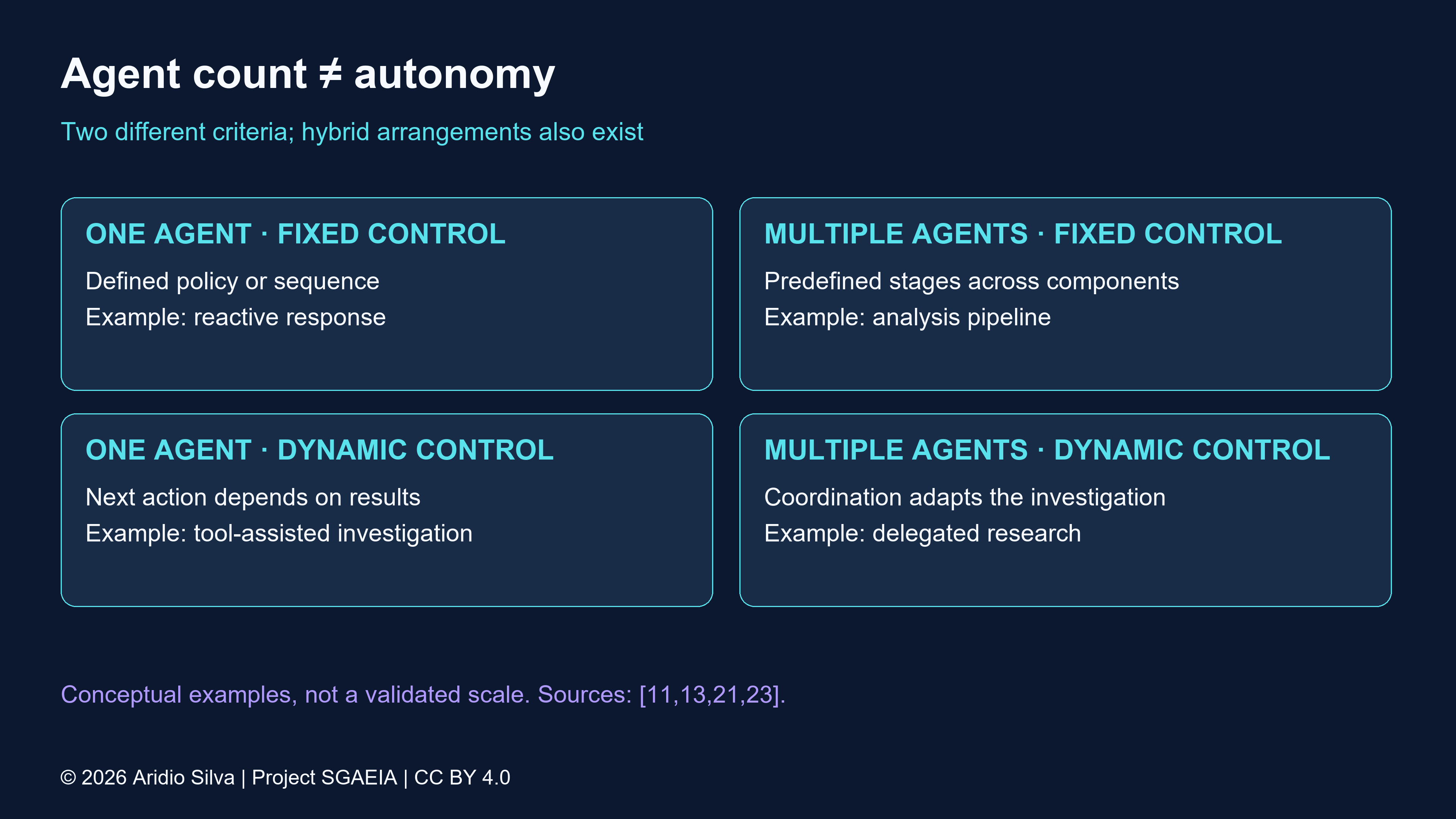
A multi-agent architecture may support specialization, parallel investigation, and distribution of context. It also introduces communication costs, dependencies, and difficulties in verifying individual contributions. Anthropic's research system provides a technical example of coordination, but its reported gains are internal results under specific conditions. AutoGen demonstrates an architecture based on agent conversations; the architecture's existence does not guarantee that every configuration is more autonomous or reliable. [14,21]
Memory is not synonymous with learning model parameters. Recording a conversation, retrieving documents, and maintaining task state may change behavior without updating weights. Likewise, revising a plan after new observations does not imply continual learning. Classical agents and current applications can operate with fixed policies and models; learning during execution is an additional possibility, rather than a universal condition of agency. [1,7]
Generative AI and agentic AI also answer different questions. The former primarily characterizes content production, whereas the latter emphasizes the organization of goal-directed decisions and actions. A generative model can power a chatbot without controlling a process, while a classical agent can act without generating language. When a provider presents agentic AI as an evolution of generative AI, the scope of products to which that statement applies should be identified. [1,11,24]
5. How providers use the terms
The following comparison examines definitions and architectural choices published by the providers themselves. It is neither a frontier-model ranking nor a measurement of product capability, security, or cost. The comparison concerns technical vocabulary in particular documents. Even within one organization, conceptual pages and frameworks may operate at different levels of abstraction.
| Organization | Observed usage | Conceptual implication |
|---|---|---|
| OpenAI | Agents perform tasks on a user's behalf; in LLM-based agents, the model controls the workflow and uses tools. [11,12] | Emphasis on execution control, without requiring multiple agents. |
| Anthropic | “Agentic systems” include workflows and agents; workflows follow defined paths, while agents dynamically direct processes and tools. [13] | Agentic can be broader than the agent category used in the same text. |
| A Google Cloud conceptual page emphasizes collaboration among agents; ADK distinguishes LLM-based agents, workflows, and other classes. [15,16] | A commercial definition should not be treated as a universal boundary for the framework or the field. | |
| Microsoft | The FAQ uses broad accounts of agents; Agent Framework combines agents and workflows. [19,20] | Delegation, composition, and control must be specified for each application. |
| AWS and IBM | The consulted sources allow systems with one or more agents. [23,24] | “Agentic necessarily means multi-agent” fails as a cross-provider rule. |
| Mistral | Tools, instructions, goals, and handoffs are components of agent applications. [26,27] | Product components do not establish a universal taxonomy. |
| Meta | Historical Llama 3.1 materials describe models within tool-using systems. [28] | Model, application, and system must be distinguished; this source does not represent the entire current catalog. |
The contrast between OpenAI and Anthropic is particularly instructive. In OpenAI's guide, workflow control and tool use are central to its delineation of LLM-based agents. Anthropic uses agentic systems to include both predetermined workflows and model-directed agents. These accounts need not imply an operational contradiction: the expressions refer to differently scoped sets of objects. [11–13]
For Google, the conceptual page should be read alongside ADK documentation, which organizes orchestration mechanisms without reducing every application to one configuration. DeepMind's research on advanced assistants adds questions about delegation, alignment, and social interaction; Google's approach to secure agents examines protections for tool-using applications. These documents address problems that cannot be resolved simply by choosing between two labels. [15–18]
At Microsoft, Agent Framework and AutoGen illustrate different ways to compose applications. The shared responsibility model distinguishes platform and application obligations, reinforcing the importance of integration and operation for security. IBM also discusses agent risks and mitigations alongside conceptual definitions. A product's being called agentic is not defensible evidence that it is secure or superior. [19–22,25]
AWS, IBM, and Mistral broaden the comparison, although they do not occupy identical positions in frontier-model development. Their inclusion helps explain how the terms circulate in architecture and markets. The cited Meta documents are historical and distinguish models from applications, without attributing a current, exhaustive definition of agentic AI to them. Conceptual analysis should make these differences in role and period explicit. [23,24,26–28]
6. What changes technically — and what remains limited
The main technical gain of LLM-based agents is the combination of goal interpretation, tool use, and feedback during execution. This may reduce the need to anticipate every sequence in an open-ended task. Dynamic decisions, however, can make behavior, cost, and completion time less predictable. For stable tasks, an explicit workflow may be simpler to validate and operate; Anthropic itself recommends starting with simple architectures. [6,11,13]
Additional components may broaden investigative coverage while introducing coordination failures. Cemri and colleagues propose MAST, a taxonomy of 14 failure modes organized into three groups, based on analysis of multi-agent system trajectories. The taxonomy helps identify design problems, inter-agent misalignment, and verification or termination failures. It does not establish that multi-agent systems are always inferior, nor does it exhaust every possible failure type. [35]
Evaluation should consider completed tasks, rather than only the plausibility of a final response. Kapoor and colleagues highlight methodological problems and the relationship between quality and cost. Tau-bench evaluates agent–user–tool interactions, including consistency across repeated executions. Its pass^k measures success across all k repetitions and should not be confused with pass@k, which concerns at least one successful attempt. Historical rates apply to the versions and conditions evaluated, rather than the whole technology in 2026. [29,30]
Tool access amplifies the effects of errors and attacks. AgentDojo examines prompt injection in environments where untrusted content can influence agent actions. This makes minimal permissions, confirmation of sensitive actions, and result validation relevant alongside model quality. No single benchmark establishes production security: conclusions depend on the evaluated scenario, attacks, tools, and defenses. [18,22,31]
MCP and A2A address interoperability at different levels. MCP organizes integration with tools and context, whereas A2A concerns communication and collaboration among agents. Both can support agentic architectures, but their adoption demonstrates neither autonomy, correctness, legitimate authority, nor attack resistance. They are integration protocols, rather than tests of agency or security certifications. [32,33]
7. SGAEIA's contribution: capability and authority
Within SGAEIA, the distinction between capability and authority provides useful context for analyzing autonomy. An application may be capable of querying records, sending messages, and executing operations, while its authorization for a particular task permits only retrieval and preparation of a recommendation. The scope, conditions, and revocability of authority should be defined independently of model capability. The project and the article on bounded, revocable authority are cited for this specific conceptual contribution. [36,37]
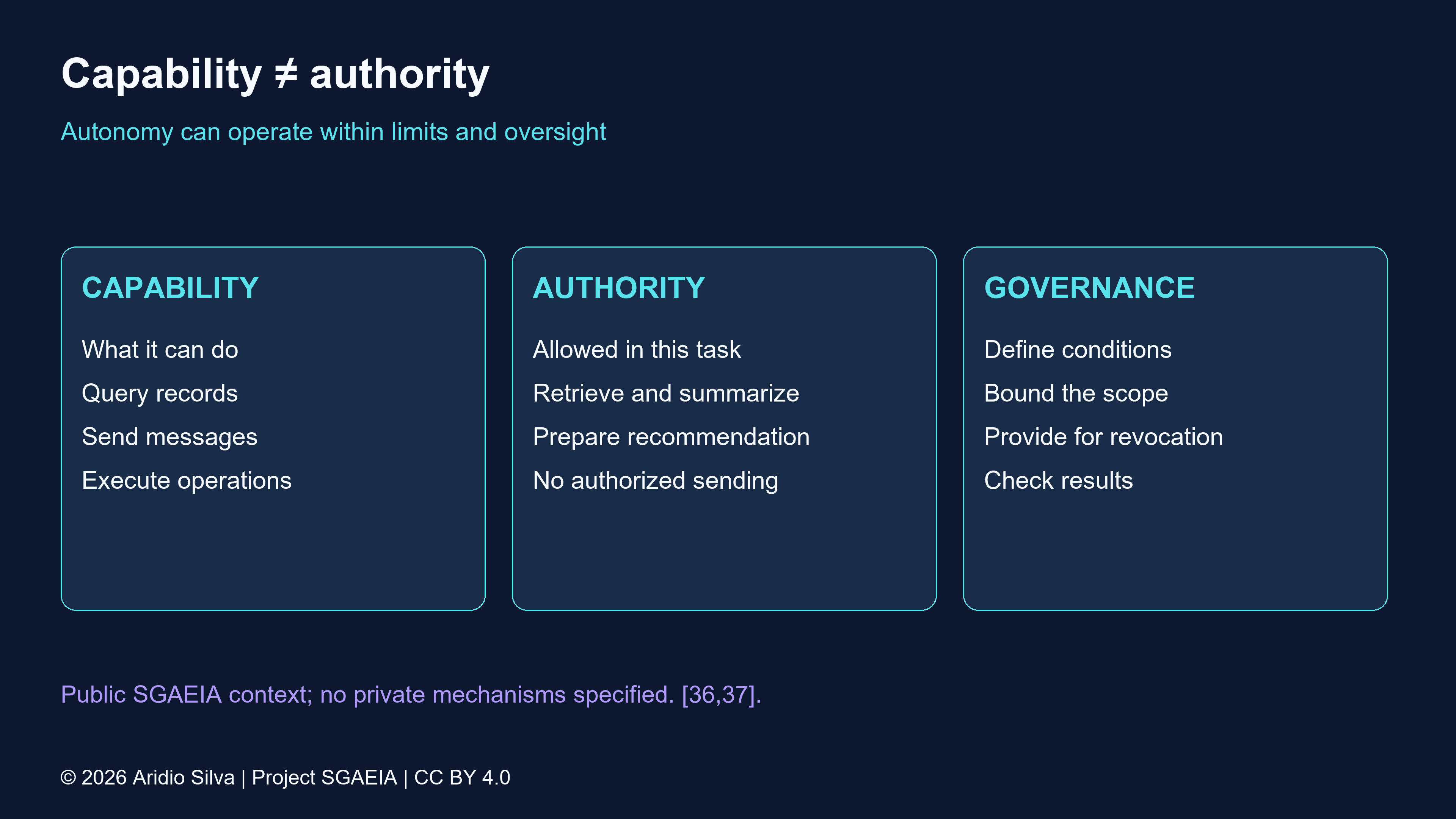
These references are the author's own works and do not constitute an independent architectural evaluation, experimental validation, or proof of this article's proposed taxonomy. Their purpose is to make a governance implication explicit: a system can select means within a delegated objective without receiving unlimited authority. Human oversight and execution constraints can coexist with agency. Controls should be examined for what they actually prevent, permit, and record, rather than through a commercial label.
8. Is the distinction defensible, or is it marketing?
The distinction is conceptually and technically defensible when it identifies analytical levels and observable properties. It is not defensible as a universal boundary separating “simple agents” from a necessarily multi-agent, autonomous technology. An agent is a functional unit; agenticness is a contextual property; an agentic system is an organization of components. These meanings can overlap in the same object.
Marketing contributes to the terms' circulation and often obscures these nuances. This does not make agency an empty concept, nor does it make every use of agentic AI purely promotional. The academic agent tradition, feedback-driven architectures, and delegation problems provide substantial technical content. The problem arises when a particular definition is presented as consensus, or when a label replaces evidence of behavior.
When comparing systems, it is more informative to ask who chooses the next action, how results change the trajectory, how long the objective persists, which permissions apply, and how failures are checked. Agent count and tool selection can then be examined as architectural decisions. Defining these criteria reduces ambiguity across research, documentation, and products. This article's contribution is to organize that reading while preserving source diversity and evidential limits.
Glossary
| Term | Meaning in this article |
|---|---|
| AI agent | Functional unit that observes and acts in an environment; its concrete definition depends on the adopted tradition. |
| Agenticness | Contextual profile of control, adaptation, and goal-directed execution; not a universal index. |
| Agentic AI | Expression used for goal-directed behaviors or systems; its scope varies across sources. |
| Multi-agent system | Composition of more than one agent; multiplicity does not determine autonomy. |
| Workflow | Process organized into stages; it may be fixed, hybrid, or partly model-controlled. |
| Autonomy | Delegated control over choices under specified conditions. |
| Feedback | Use of observed results to guide subsequent actions. |
| BDI | Agent tradition using beliefs, desires, and intentions as computational abstractions. |
| Memory | Maintained or retrieved state or information; it does not imply weight updates. |
| Learning | Changes to a policy or model through experience; distinct from information retrieval. |
| Tool | Interface through which an application obtains information or performs actions. |
| Handoff | Transfer of a task or its control to another agent. |
| Authority | Valid permission to act within a particular task, scope, and condition. |
| Prompt injection | Attempt to redirect behavior through instructions embedded in untrusted content. |
| MCP / A2A | Protocols for tool/context integration and inter-agent integration, respectively. |
References
[1] Russell, S.; Norvig, P. Artificial Intelligence A Modern Approach. 4th ed., chapter 2. Official author materials. 2020. Primary source. Type: Author-provided educational material.
[2] Wooldridge, M.; Jennings, N. R. Intelligent agents theory and practice. The Knowledge Engineering Review, 10(2), 115-152, 1995. DOI 10.1017/S0269888900008122. Primary source. Type: Classical academic paper.
[3] Shoham, Y. Agent-oriented programming. Artificial Intelligence, 60(1), 51-92, 1993. DOI 10.1016/0004-3702(93)90034-9. Primary source. Type: Classical academic paper.
[4] Rao, A. S.; Georgeff, M. P. BDI Agents From Theory to Practice. Proceedings of ICMAS, 312-319, 1995. Primary source. Type: Classical academic paper.
[5] Bandura, A. Social Cognitive Theory An Agentic Perspective. Annual Review of Psychology, 52, 1-26, 2001. DOI 10.1146/annurev.psych.52.1.1. Primary source. Type: Psychology antecedent; public abstract.
[6] Yao, S. et al. ReAct Synergizing Reasoning and Acting in Language Models. ICLR 2023; 2022 preprint, arXiv 2210.03629. Primary source. Type: Peer-reviewed technical research.
[7] Wang, L. et al. The Rise and Potential of Large Language Model Based Agents A Survey. arXiv 2309.07864, 2023. Primary source. Type: Academic survey; consulted arXiv version.
[8] Sapkota, R.; Roumeliotis, K. I.; Karkee, M. AI Agents vs. Agentic AI A Conceptual Taxonomy Applications and Challenges. Information Fusion, 126, 103599, 2026; online publication: 22 August 2025. DOI 10.1016/j.inffus.2025.103599; arXiv v5: 30 September 2025. Primary source. Type: Journal-published conceptual taxonomy.
[9] Botti, V. Agentic AI and Multiagentic Are We Reinventing the Wheel? arXiv 2506.01463, 2 June 2025. The PDF uses the title variant Agentic AI and Multi-Agent Systems. Primary source. Type: Critical preprint essay.
[10] Arunkumar V.; Gangadharan, G. R.; Buyya, R. Agentic Artificial Intelligence AI Architectures Taxonomies and Evaluation of Large Language Model Agents. arXiv 2601.12560, 18 January 2026. Primary source. Type: Survey preprint.
[11] OpenAI. A practical guide to building agents. Technical guide, 34 pages, undated. Primary source. Type: Official provider guide.
[12] OpenAI. Agents. Official API documentation, page current at consultation. Primary source. Type: Official technical documentation.
[13] Anthropic. Building effective agents. 19 December 2024; page subsequently updated with tooling information. Primary source. Type: Official architectural distinction.
[14] Anthropic. How we built our multi-agent research system. 13 June 2025. Primary source. Type: Technical account and internal evaluation.
[15] Google Cloud. What is agentic AI Definition and differentiators. Updated 16 September 2026. Primary source. Type: Provider conceptual page.
[16] Google. Agent Development Kit Agents. Current documentation; original address redirects to adk.dev. Primary source. Type: Official technical documentation.
[17] Gabriel, I. et al. The Ethics of Advanced AI Assistants. Google DeepMind, 2024; arXiv 2404.16244. Primary source. Type: Delegation and risk research.
[18] Google Research. An introduction to Googles approach for secure AI agents. 2025. Primary source. Type: Official technical research record.
[19] Microsoft. AI Agents FAQ. Microsoft 365 Copilot, page current at consultation. Primary source. Type: Official provider definitions.
[20] Microsoft. Microsoft Agent Framework Overview. Microsoft Learn, current documentation. Primary source. Type: Official technical documentation.
[21] Wu, Q. et al. AutoGen Enabling Next-Gen LLM Applications via Multi-Agent Conversation. COLM 2024; arXiv 2308.08155, 2023. Primary source. Type: Peer-reviewed technical research.
[22] Microsoft. AI agent shared responsibility model. Microsoft Learn, current documentation. Primary source. Type: Official technical governance documentation.
[23] AWS. Definitions. AWS Well-Architected Agentic AI Lens, current documentation. Primary source. Type: Official architectural definition.
[24] IBM. Agentic AI vs. Generative AI. IBM Think, page current at consultation. Primary source. Type: Provider conceptual definition.
[25] IBM. AI agents Opportunities risks and mitigations. White paper, 15 pages, 2025. Primary source. Type: Technical risk discussion.
[26] Mistral AI. Agents Introduction. Official documentation, page current at consultation. Primary source. Type: Official technical definition.
[27] Mistral AI. Build AI agents with the Mistral Agents API. 2025. Primary source. Type: Official technical announcement.
[28] Meta. Introducing Llama 3.1 Our most capable models to date. 23 July 2024. Primary source. Type: Historical official architecture record.
[29] Kapoor, S. et al. AI Agents That Matter. arXiv 2407.01502, 2024. Primary source. Type: Evaluation and cost research.
[30] Yao, S.; Shinn, N.; Razavi, P.; Narasimhan, K. tau-bench A Benchmark for Tool-Agent-User Interaction in Real-World Domains. 2024; ICLR 2025. Primary source. Type: Interaction and reliability benchmark.
[31] Debenedetti, E. et al. AgentDojo A Dynamic Environment to Evaluate Prompt Injection Attacks and Defenses for LLM Agents. arXiv 2406.13352, 2024. Primary source. Type: Security benchmark.
[32] Model Context Protocol. Architecture overview. Official documentation, revision 2026-07-28 at consultation. Primary source. Type: Protocol architecture documentation.
[33] A2A Protocol. What is A2A. Current official documentation. Primary source. Type: Interoperability protocol.
[34] Shavit, Y.; Agarwal, S.; Brundage, M. et al. Practices for Governing Agentic AI Systems. OpenAI, 14 December 2023; especially section 2.1. Primary source. Type: Provider governance research white paper.
[35] Cemri, M. et al. Why Do Multi-Agent LLM Systems Fail? NeurIPS 2025, Datasets and Benchmarks; arXiv 2503.13657v3, 26 October 2025. Primary source. Type: Peer-reviewed empirical research; MAST taxonomy.
[36] Silva, Aridio. (2026). SGAEIA Secure Governed Autonomous Edge Intelligence Architecture. Research software artifact and reference architecture. Zenodo. DOI 10.5281/zenodo.22557796. Public project description. Primary source. Type: Author-owned research artifact; architectural context, not independent evaluation.
[37] Silva, Aridio. (2026). Why Autonomous AI Agents Need Bounded and Revocable Authority. SGAEIA Research Series, Article 2. DEV edition, 1 October 2026. Work DOI 10.5281/zenodo.22715664. Primary source. Type: Author-owned conceptual article; not experimental evidence.
About the author
Aridio Silva is an independent researcher based in Brazil working on the architecture, security, governance, and trustworthiness of autonomous and distributed AI systems. His work examines how model capabilities become actions in real applications. This perspective connects technical autonomy with authority boundaries and behavioral evidence.
His research covers Agentic AI, Multi-Agent Systems, Edge AI, AI Security, Zero Trust, Security-by-Design, AI Governance, Specification-Driven Development, and continuous security assurance. These concepts are addressed at their respective levels of abstraction and evidence. Architectural proposals are not presented as certifications or production guarantees.
He is the creator and lead researcher of SGAEIA, an open research initiative investigating architectural foundations for secure, governed, auditable, and trustworthy autonomous AI across distributed edge–cloud environments. The project provides the context for his SGAEIA Research Series publications. This article discusses public concepts without specifying private project mechanisms.
Research & Project Resources
- ORCID: https://orcid.org/0009-0008-2411-6995
- Google Scholar: https://scholar.google.com/citations?user=rPn5O48AAAAJ
- Zenodo — SGAEIA Community: https://zenodo.org/communities/sgaeia
- OpenAIRE: https://explore.openaire.eu/search/find?fv0=Aridio%20Silva&f0=q
- Medium: https://medium.com/@aridiosilva
- DEV Community: https://dev.to/aridiosilva
- GitHub: https://github.com/aridiosilva
- LinkedIn: https://www.linkedin.com/in/aridio-silva-74997111/
- Homepage: https://aridiosilva.com
- SGAEIA Homepage: https://aridiosilva.com/sgaeia
- SGAEIA LinkedIn: https://www.linkedin.com/company/sgaeia/
- Kaggle: https://www.kaggle.com/aridiosilva2
- Academia.edu: https://independent.academia.edu/AridioSilva
Figures
The cover image is not numbered. Figures 1–3 are numbered sequentially and referenced consistently in this article.
All images are original conceptual illustrations prepared for this article. They carry visible attribution and publication metadata identifying Aridio Silva as creator, SGAEIA as the project, and CC BY 4.0 as the license. They remain within the public disclosure boundary by communicating properties and high-level governance relationships without exposing private protocols, algorithms, state machines, policy logic, or reconstruction-enabling implementation details.
Suggested citation
Silva, Aridio. (2026). AI Agents and Agentic AI: What Sets Them Apart? SGAEIA Research Series, Article 20. Revised 14 October 2026. CC BY 4.0. DOI: 10.5281/zenodo.23373900
Read the full article on MediumZenodo recordDEV CommunityAcademia.edu
Corresponding edition
Portuguese edition. The Portuguese edition is the project's reference; both editions preserve the argument, figures, and reference numbering.
License
Except where otherwise noted, the text and original conceptual illustrations in this article are licensed under the Creative Commons Attribution 4.0 International License (CC BY 4.0).
© 2026 Aridio Silva. You may share and adapt this work for any purpose, provided appropriate attribution is given.
The SGAEIA software research artifact remains subject to its own Apache License 2.0.
Autonomous AI. Governed by Design. Trusted by Evidence.